
Digital media changed the game
How did digital technologies go from a tool to a belief system, and how do we get our agency back?
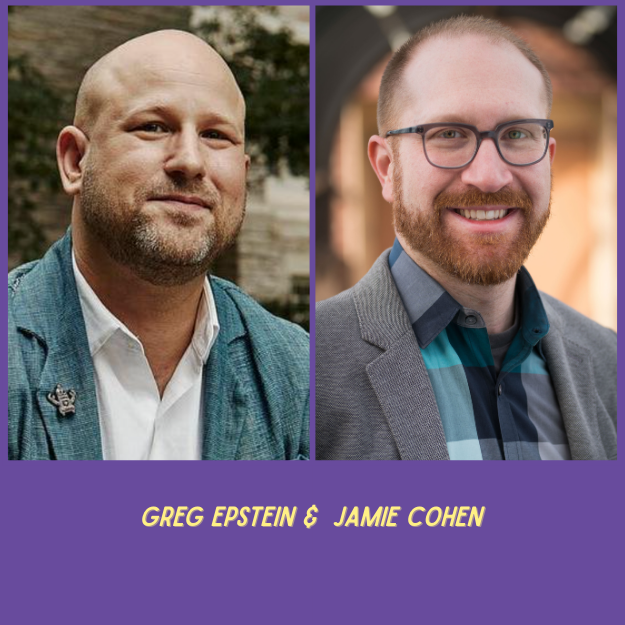
Greg M. Epstein (pictured left, Photo Credit: Cody O’Laughlin) serves as Humanist Chaplain at Harvard & MIT, where he advises students, faculty, and staff members on ethical and existential concerns from a humanist perspective.
Jamie Cohen (pictured right) is an associate professor of Media Studies at CUNY Queens College and Salzburg Academy on Media and Global Change faculty fellow, where his work focuses on internet literacies, memes, and visual media.
Digital technologies have been fundamental to the proliferation and perpetuation of cults of all kinds. Joining Dr. Mara Einstein for an examination of belief, power, and persuasion are two very special guests: one a theologian and the other an internet scholar. Together they make the case that we are not just living with technology—we are living inside its belief systems. And without conscious resistance, reform, and real-world community, those systems will continue to define reality for us.
In Part 1, Dr. Mara speaks with Greg Epstein, humanist chaplain at Harvard and author of Tech Agnostic. From founders as prophets to platforms as congregations, tech didn’t just borrow religious metaphors—it replaced religion for many people, without the safeguards, humility, or reform movements that traditional religions developed over time. But if tech behaves like a religion, does it also behave like a cult? Together, Dr. Mara and Greg unpack charismatic leaders, apocalyptic thinking around AI, the myth of “doing good,” and why some of the most powerful people in tech may sincerely believe they’re saving the world—while making democracy, equality, and community harder to sustain.
In Part 2, Dr. Mara is joined by Jamie Cohen, a media scholar who studies digital culture, from surveillance capitalism to online radicalization. Algorithms, advertising infrastructure, data extraction, and prediction systems don’t just sell products—they sort people into belief systems. Micro-targeted ads, grievance-based online movements, incel and extremist ecosystems, and how algorithms reward identity silos, free labor, and radicalization all connect directly to cult dynamics: closed information loops, in-group language, moral certainty, and the increasing difficulty of exit.
Part 1 – Greg Epstein
How Silicon Valley mirrors religion: prophets, doctrine, rituals, hierarchies
Why social media platforms function like congregations
Why AI discourse increasingly resembles theology (including explicit “AI God” language)
The “drama of the gifted technologist” and why exceptionalism erodes community
Why reform, not blind rejection, is the only viable path forward
A practical framework for living with technology without worshiping it
Part 2 – Jamie Cohen
What algorithms really are—and why “recipe” is a good metaphor
How prediction systems shape future behavior, not just reflect past behavior
Why algorithms don’t create beliefs—but harden them
Why extremist ecosystems are highly profitable—and largely invisible to outsiders
How free labor, identity performance, and “self-improvement” fuel digital cults
Why Gen Z fears face-to-face interaction—and how surveillance culture shaped that fear
Why wonder, awkwardness, and real community are acts of resistance
Mentioned in this episode:
Books
Tech Agnostic — Greg Epstein
Good Without God — Greg Epstein
Hoodwinked — Dr. Mara Einstein
Life 3.0 — Max Tegmark
The Drama of the Gifted Child — Alice Miller
Concepts & Frameworks
Tech as religion
Cult leadership and charismatic authority
Algorithmic prediction systems
Surveillance capitalism
Grievance media ecosystems
Digital radicalization and echo chambers
Platforms & Industries
Social media platforms
AI development and generative systems
Digital advertising and influencer economies
Documentaries
None this episode
Scholars, Thinkers, and Public Figures
Greg Epstein — humanist chaplain, author, scholar of religion and ethics
Jamie Cohen — media scholar focused on algorithms, online culture, and extremism
Max Tegmark — physicist and AI theorist
Alice Miller — psychologist and author
Mark Zuckerberg — referenced in discussion of tech as moral infrastructure
About the guest — Greg Epstein
Greg M. Epstein serves as Humanist Chaplain at Harvard & MIT, where he advises students, faculty, and staff members on ethical and existential concerns from a humanist perspective. He was TechCrunch's first “ethicist in residence” and has been called “a symbol of the transition in how Americans relate to organized religion” (The Conversation). He is the author of the New York Times-bestselling book Good Without God and has also written for MIT Technology Review, CNN.com, The Boston Globe, The Washington Post, and Newsweek. His most recent book is Tech Agnostic: How Technology Became the World's Most Powerful Religion, and Why It Desperately Needs a Reformation.
About the guest — Jamie Cohen
Jamie Cohen is an associate professor of Media Studies at CUNY Queens College. He is also a Salzburg Academy on Media and Global Change faculty fellow. Jamie is a digital culture expert, and his work focuses on internet literacies, memes, and visual media. His current project isAngry Boys Among Us: How the Manosphere Became Culture, and What We Can Do About It, an exploration of the manufactured manosphere created by an interconnected network of online men’s influencers and entertainers who subsist and profit by exploiting vulnerable young men’s fears and anxieties.
About the host
Dr. Mara Einstein spent a decade in corporate marketing working for some of the world’s biggest brands before turning her focus to exposing the industry’s inner workings. Now a tenured professor of media studies at CUNY, she’s dedicated to helping people understand how marketing shapes what we buy, what we believe, and even who we think we are. With a background spanning business, media, and the arts, Dr. Einstein brings sharp insight and humor to the systems that sell us our identities—and the power we have to push back.
Pick up Dr. Einstein’s book Hoodwinked: How Marketers Use the Same Tactics as Cults on
Bookshop.org (and beyond): https://bookshop.org/a/116018/9781493086153
Website: https://www.drmaraeinstein.com
Books: https://www.drmaraeinstein.com/writing
Instagram, TikTok, Threads: @drmaraeinstein
YouTube: https://www.youtube.com/@Drmaraeinstein
Credits
Production: Multitude
Lead Producer & Editor: Bren Frederick
Music: Marc Langer
Cover art: Cayla Einstein